


Arvin Goods
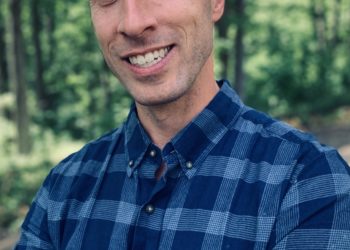
Dustin Winegardner is a long-time apparel industry executive who sees a chance to create a cleaner industry. Arvin Goods
It probably took about 150 gallons of water to make the pair of standard cotton/polyester socks on your feet. Seriously.
For years, Dustin Winegardner, the founder of Seattle-based Arvin Goods, lived with this knowledge, of vast amounts of natural resources consumed by apparel manufacturing. Then, two-and-half years ago, he saw a narrow path through the wall of conformity. The path would be paved with underwear and socks — a $4.6 billion category.
Volume businesses like clothing are bad for the environment and often have poor labor standards, to boot. Cotton requires a lot of water to grow, a problem that is magnified because so many clothes are produced in India, where irrigation is inefficient and pesticide use is prevalent.
For years, as an executive, Winegardner tried unsuccessfully to sell big companies on the idea that consumers would pay more for an environmentally sound brand.
But it was a no-go. No one knows if consumers will see good-for-the-planet the same way they see luxury , triggering their willingness to pay more. “Organic” has taken root, but that’s essentially a selfish message , something like: “If you buy this product, you’ll be healthier.”
Big companies doubt the altruism of their consumers. “There’s no financial incentive for the giants to change their supply chain for the long-term good,” he said. “If you work at a publicly traded company and the numbers dip, you’re out of a job. You’ve got Squawk Box ready to take you down.”
“I saw the massive scale of the basics category. It’s a repeated purchase,” he said. “And no one had sustainability as the starting point for a brand. I knew I had to make socks.”
He founded Arvin Goods to sell socks and underwear made from a 50/50 blend of cotton cutting waste and post-consumer plastic bottles. Set to hit $1 million in revenue this year, Arvin grew out of a couple of key turning points in the industry, including the availability of the material Arvin’s garments are made from and the faith of some mom-and-pop retailers in Arvin.
Arvin is appearing this summer in Urban Outfitters with socks that retail for about the same price as other high-end socks, $10-$14.
“If Arvin becomes a $100 million company … my impact is nothing,” Winegardner said. “I wouldn’t actually make any impact on sustainability.”
Turning Point #1: Recognizing the Desire for Change
Winegardner recognized that many people within the apparel manufacturing system wanted to do better by the planet, but felt hamstrung.
One of his clothing clients, Volcom, tried to launch an ecologically sound micro collection. He looked into it. The costs were only marginally higher — sometimes only about 10% — but in a business where the profits are often less than 20%, a 10% hit is a devastating number.
Turning Point #2: Sustainability Becomes a Buzzword
Then, about five years ago, the idea of sustainability took root, and companies started selling organic cotton (though it doesn’t necessarily have an impact on water use). Many still didn’t have an appetite for the risk of launching higher-priced clothing, but Winegardner recognized that in business as well as life, the aspiration is often the starting point.
ITC, the Amsterdam conglomerate that Winegardner still works for, asked him to develop a platform of environmentally better material. He found an 80-year-old yarn mill in Spain that had been recycling remnants of cotton yarn for 40 years. But they’d discovered how to do it more cost-effectively. It was cheaper. In other cases, suppliers had figured out how to make yarn out of recycled bottles.
Turning Point #3: Arvin Launches
Winegardner approached his employers about launching a brand, which would make the concept easier to sell in the United States. In September 2016, he started developing Arvin. Executives at ITC were supportive; eventually Winegardner developed Arvin and separated it from ITC. It launched as a separate company in June 2017.
He and designer Harry Fricker now own a majority of it.
In November 2016, the first samples arrived. “We put them on our feet, and I knew we could make as good or better (than standard socks),” Winegardner said. “I have millions of socks in my background.”
The first idea was to sell their product in big retail chains. But their packaging and web site didn’t explain quickly enough why consumers should invest more than $10 in socks, and retailers didn’t bite.
Turning Point #4: Focusing on Messaging, and Mom and Pops
So he and Fricker scaled back for six months. “Let’s focus on our own messaging. Let’s have total control of the story.”
That worked. That has led to more wholesale distribution in regional and mom-and-pop retailers. A handful of those that took a risk early were Shoeaholic in Eugene, Oregon; Woosah, in Grand Rapids, Mich.; Bridge and Burn, and Citizen Supply in Atlanta, Ga. Winegardner had met the owner at a trade show. “They took a flyer on us and gave us our first full brand position,” he said. The sales gave him a story to take to Urban Outfitters.
Cascading Change
Now the question is whether consumers are ready to hear what Arvin is saying, and still, whether Winegardner and Fricker have honed the message enough.
“Consumers will pay more for better,” said Winegardner. “But you only have about seven seconds to make them understand that something is better.”
Winegardner has relied on auditing services, including BSCI and WRAP, that work in apparel manufacturing to certify that the socks, underwear and beanies, are made sustainably and without abusive labor practices.
The cutting, stitching and knitting of the socks is done in China. Winegardner has a relationship with the owner of the factory, and he says he’s been there many times.
“Our barrier to growth is nothing more than consumer education,” he said. “People hear sustainability but they don’t know what it means.”
Originally published in Forbes.com, April 22, 2019
This story and others on Times of E are made possible by a sponsorship from the Ewing Marion Kauffman Foundation. The Ewing Marion Kauffman Foundation is a private, nonpartisan foundation that provides access to opportunities that help people achieve financial stability, upward mobility, and economic prosperity – regardless of race, gender, or geography. The Kansas City, Mo.-based foundation uses its grantmaking, research, programs, and initiatives to support the start and growth of new businesses, a more prepared workforce, and stronger communities. For more information, visit www.kauffman.org and connect with www.twitter.com/kauffmanfdn and www.facebook.com/kauffmanfdn.